

Tom Carter is a well-known Vancouver-based musician and painter. His artwork is distinguished by its depiction of Vancouver’s streets at different points in the 20th century. Although Carter was born in the suburbs, where he spent much of his early life, he always longed for city life. As his personal circumstances changed, he began studying urban history in detail. More on the website vancouver1.one.
How His Interest in Vancouver’s History Began
Before Tom Carter started painting, he spent twenty years running his own recording studio. He was involved in producing blues albums that were nominated for the Juno Awards. At first, he enjoyed the work, but over time, he realized that it wasn’t something he wanted to do for the rest of his life.
After selling the studio, Carter bought a loft in downtown Vancouver. Around this time, he discovered that his grandfather had also undergone major life changes at the same age. This coincidence sparked his interest in exploring his family’s history.
Carter learned that his grandfather owned a chain of restaurants in downtown Vancouver during the 1920s and 1930s. However, the business shut down in 1933 after the Chicago mafia bombed a theatre known as the Royal Theatre, which was located directly across from his grandfather’s café. Rumours suggested that the bombing was linked to labour unrest at the time.
This discovery motivated Carter to delve deeper into both his own family’s history and that of the entire city. Eventually, he decided to capture his findings on canvas. His goal was to portray Vancouver as it was known by previous generations—his parents, grandparents, and great-grandparents. Carter’s first historical Vancouver paintings were created simply to decorate his own walls. At the time, he had no idea that his work would gain popularity and provide him with a living.
Research Comes Before Painting
According to the artist, the more research he conducts, the easier it is to paint. Carter spends countless hours searching through historical records at the city archives and speaking with elderly Vancouver residents. For him, studying the city is just as enjoyable as painting it.
Carter’s paintings are notable for their high level of detail, but he also allows himself artistic freedom. In an interview, he explained that he often uses “creative perspective”, meaning he distorts or exaggerates certain elements to give the viewer a more immersive experience.
For example, he might bend or stretch buildings to provide a panoramic effect, or shrink parking lots to highlight interesting structures or neon signs. This is why Carter prefers painting over photography—because artistic techniques allow for a richer storytelling experience than a camera lens ever could.
A Love for Hastings Street and Vancouver’s Nightlife
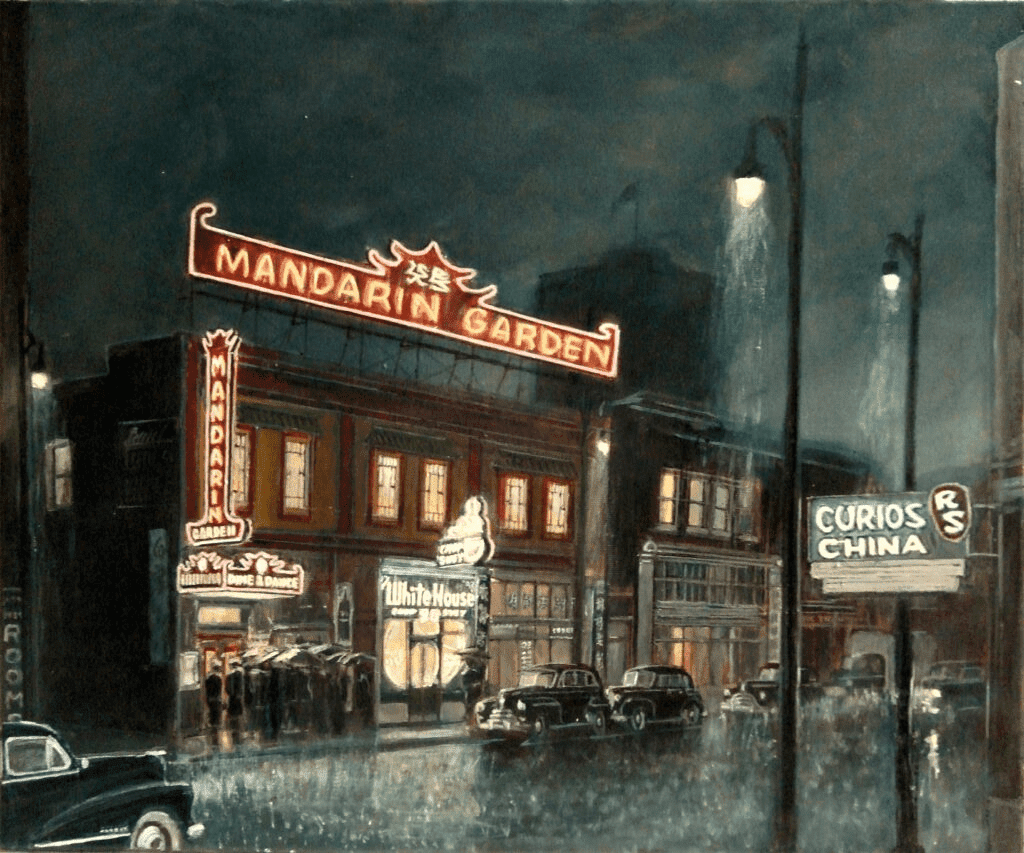
Carter’s favourite subject is Hastings Street, which he frequently paints at night. His works capture the neon lights, rain-soaked streets, and vibrant urban culture of Vancouver.
The 1940s to 1960s era is one of his favourite time periods to depict, as it is widely recognizable and resonates with many viewers. On a personal level, these decades hold special significance because they are closely connected to his family’s history. By drawing inspiration from his ancestral research, Carter seamlessly weaves together historical and personal narratives in his paintings.
One City, Different Eras
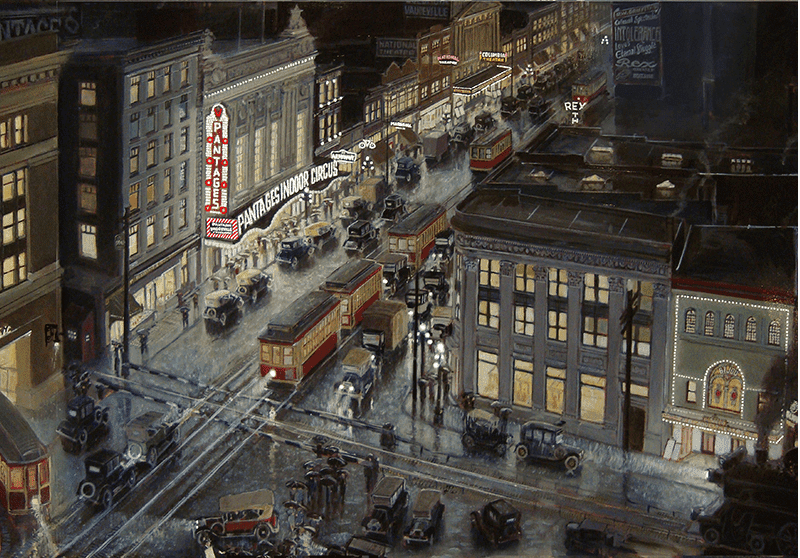
In Carter’s early works, there is a noticeable overlap of different time periods. This technique allows him to reintroduce long-demolished buildings into modern cityscapes, preserving their historical significance.
Additionally, he sometimes depicts multiple time periods within a single structure—showing different floors or rooms as they would have appeared in various decades. This blending of past and present creates a layered, almost cinematic experience, where viewers can witness Vancouver as it once was and as it is today, all in a single painting.